

Only 1 in 6 Buildings Went Up With a Permit Last Year in Punta Cana's Home Province
By the UpHoming Research Team ·
Buying ProcessIn La Altagracia, home to Punta Cana, only 1 in 6 buildings built in 2025 had a permit. Here's exactly how to check yours before you sign or wire a deposit.
Only 1 in 6 Buildings Went Up With a Permit Last Year in Punta Cana's Home Province
In 2025, builders in La Altagracia, the province that holds Punta Cana, Bávaro, and Cap Cana, finished 1,642 buildings. The government had issued construction permits for 264 of them. For every permitted building, about six went up without one, according to a cross check of Oficina Nacional de Estadística (ONE) and Ministerio de Vivienda, Hábitat y Edificaciones (MIVHED) records published in July 2026. If you're looking at a property in this area, the odds that its paperwork is actually in order are roughly 1 in 6, so it's worth knowing how to check before you sign anything.
How do I find out if my property in Punta Cana has a real construction permit?
Ask your attorney to request the permit file, called an "expediente," directly from MIVHED, or check the project yourself on the ministry's online portal, the Ventanilla Única de Construcción (VUC). A real permit comes with a case number, an issue date, and the name of the licensed engineer or architect who signed the plans. If a developer or seller can't produce those details, they don't have a permit yet, whatever the sales brochure says.
The scale of the gap explains why this question matters more here than almost anywhere else in the country. Nationally, out of 4,163 private buildings registered in 2025, only 1,362 (32.7%) had a permit, meaning roughly two out of three buildings built in the Dominican Republic that year went up without one (ONE/MIVHED, via n.com.do, July 2026). La Altagracia's gap was worse than the national average: 264 permits against 1,642 buildings, a ratio of roughly 6 to 1.
How did the gap get this wide?
Two things happened at the same time. First, La Altagracia simply built more than anywhere else in the country. The province accounted for about 40% of every private building constructed nationally in 2025, roughly 1,642 of the 4,163 total, and its construction area reached about 1.5 million square meters, more than Santo Domingo province (1.3 million m²) or the National District (958,000 m²) individually (ONE Anuario de Estadísticas Económicas 2025, via Diario Libre, September 2026). To picture that, 1.5 million square meters is roughly the footprint of 210 professional soccer fields, built in a single province in a single year.
Second, the permitting system didn't scale with that pace. In May 2026, Housing Minister Víctor "Ito" Bisonó met with La Altagracia's builders' association, ADECLA, and announced a push to modernize the VUC portal because processing times were falling behind demand (DR1.com, May 2026). Frank Rainieri, founder of Grupo Puntacana, one of the area's oldest and largest developers, said publicly in September 2026 that the region's growth was happening without "adequate regulation or a comprehensive territorial zoning plan" (DR1.com, September 2026). When a developer with that much invested in the area says the same thing regulators are now trying to fix, the pattern in the data lines up with what people on the ground are describing too.
What this means depending on what you're buying
If you're buying pre-construction, ask for the MIVHED permit number before you sign a reservation contract or wire a deposit, not after. A project whose permit is "in process" can still get approved, but it can also stall for months while the developer resolves observations from the technical review. MIVHED's own guidance sets that review at up to 60 business days for standard residential projects and up to 120 for larger tourism or mixed-use developments. That's roughly two to four months your closing date depends on.
If you're buying a finished unit, say a resale villa that's been standing for two years, the risk shifts from delay to paperwork. Registering an individual title for a condo unit in the Dominican Republic requires the developer to have filed an approved "declaración de condominio" at the Title Registry, which itself depends on approved building plans. If the underlying construction was never permitted, that filing may never have gone through correctly, which can complicate getting a clean Certificate of Title in your own name later.
And if you're financing the purchase, a bank underwriting a mortgage will typically ask for proof of a valid permit as part of its closing documents. A missing permit doesn't just create legal risk down the road. It can stop your financing before you ever reach a closing table.
The detail most coverage of this data skipped
Every article we found on this ONE-MIVHED data, including n.com.do, Diario Libre, and Acento, covered it as a story about the construction sector's growth and the government's regulatory gap. None of them turned it into a question a buyer should actually ask about a specific building. One distinction also got lost along the way: a permit "en trámite," meaning under MIVHED review, is not the same as a permit that has been granted. Developers marketing presales sometimes describe a project as having its permit "in process," which is legally accurate but tells you nothing about whether it will be approved, or when. Ask which one you're looking at. The two carry very different levels of risk.
How we did the math
The permit and building counts come from a cross check of ONE and MIVHED data, first reported by n.com.do on July 16, 2026, and referenced again by Diario Libre on September 16, 2026, citing the ONE Anuario de Estadísticas Económicas 2025. The percentages and ratios in this article were recalculated directly from those raw counts. Context on the permitting process and the quotes on the pace of growth in La Altagracia come from MIVHED's public guidance and DR1.com's May and September 2026 coverage.
Before you make an offer on anything in Punta Cana, Bávaro, or Cap Cana, get the permit expediente in writing, not a verbal assurance from a sales agent. Our attorneys in the Dominican Republic can request that file directly from MIVHED as part of your due diligence, and our fraud checklist for foreign buyers covers the other documents worth asking for before you pay a deposit.
This article is based on data from the Oficina Nacional de Estadística (ONE), the Ministerio de Vivienda, Hábitat y Edificaciones (MIVHED), and reporting by n.com.do, Diario Libre, and DR1.com, published between May and September 2026. Last updated: September 18, 2026.
Keep reading
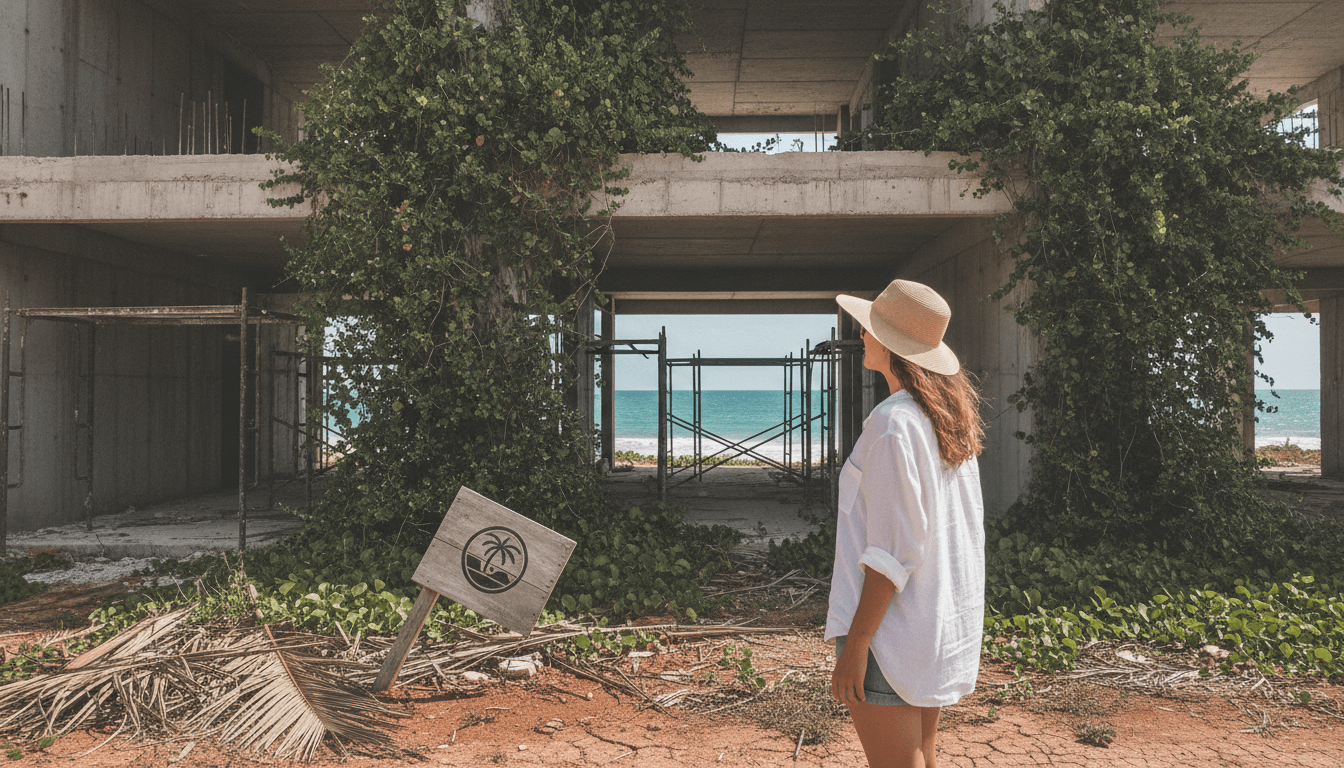
40 Buyers From Five Countries Lost Money on One Punta Cana Project — Here's the Checklist That Would Have Stopped It
June 12, 2026
Bought Pre-Construction in the DR? Your Trust May Be Quietly Costing You About $1,800 a Year in Property Tax
October 16, 2026

80 Projects Are Building Half of Santo Domingo. Here's What It Means If Yours Isn't One of Them
October 16, 2026